
Why Supplement Formulators Are Rethinking Synthetic Excipients
For decades, synthetic excipients like magnesium stearate, silicon dioxide, calcium silicate, and titanium dioxide have been the default tools in supplement manufacturing. They work reliably, cost little, and have long regulatory histories. But as consumer demand for clean label products continues to intensify, formulators are increasingly asking: what’s in my capsule beyond the active ingredient?
The answer often includes a list of synthetic processing aids that consumers don’t recognize — and don’t want. This guide breaks down the key differences between natural and synthetic excipients in dietary supplement manufacturing, covering function, label impact, and practical formulation considerations for each category.
What Makes an Excipient “Synthetic” vs. “Natural”?
In dietary supplement manufacturing, the distinction comes down to source and processing. Synthetic excipients are chemically produced or highly refined inorganic materials. Natural excipients are derived from whole-food or plant-based sources with minimal chemical processing. “Organic” is a subset of natural — it carries additional USDA certification requirements.
Neither category is inherently superior for every application. Synthetic excipients have been optimized for consistency and machine performance over many decades. Natural excipients are newer to the market and require more formulation knowledge to use effectively — but they deliver the label story that today’s consumers demand.
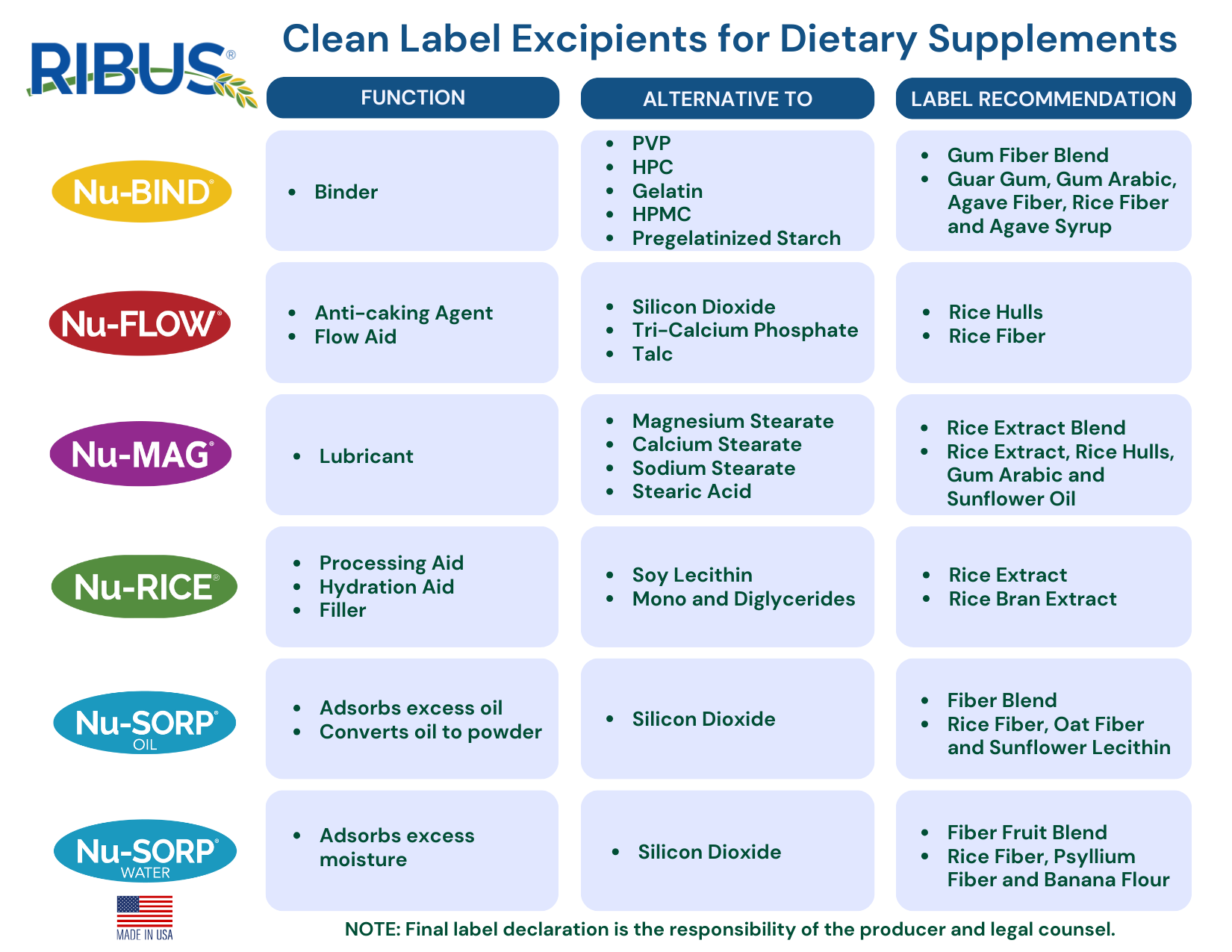
Natural vs. Synthetic Excipients: Side-by-Side Comparison
| Function | Synthetic Excipient | Natural Alternative | Label Declaration | Organic Certified? |
|---|---|---|---|---|
| Lubricant | Magnesium Stearate | Nu-MAG™ (RIBUS) | Rice Extract Blend | Yes |
| Flow Agent / Anti-Caking | Silicon Dioxide (SiO₂) | Nu-FLOW™ (RIBUS) | Rice Hulls / Rice Fiber | Yes |
| Binder | PVP, HPMC, synthetic polymers | Nu-BIND™ (RIBUS) | Gum Fiber Blend | Yes |
| Oil Adsorption / Carrier | Silicon Dioxide, Calcium Silicate | Nu-SORP™ Oil (RIBUS) | Fiber Blend | Yes |
| Water/Moisture Adsorption | Silica gel, Calcium Silicate | Nu-SORP™ Water (RIBUS) | Fiber Fruit Blend | Yes |
| Filler / Bulking Agent | Microcrystalline Cellulose (MCC), Di-Cal Phosphate | Nu-FILL™ (RIBUS) | Rice Syrup Blend | Yes |
Lubrication: Magnesium Stearate vs. Natural Rice-Based Lubricants
Magnesium stearate is the most widely used lubricant in supplement manufacturing — and the one consumers object to most strongly. It’s a synthetic salt derived from stearic acid and magnesium, added to prevent ingredients from sticking to capsule filling equipment and tablet presses. It works well, but at a formulation cost: it’s hydrophobic, which can slow tablet disintegration and potentially impact absorption. On a label, “magnesium stearate” reads as a chemical additive to health-conscious buyers.
Nu-MAG™ from RIBUS is the leading natural lubricant alternative. Made from a rice extract blend — including rice hulls, rice bran, and rice bran wax — it delivers equivalent lubrication performance with one major advantage: it labels as “Rice Extract Blend.” Nu-MAG is certified organic, non-GMO, and allergen-free. Because it is not hydrophobic, it does not compromise disintegration time. Formulators switching from magnesium stearate typically start with a 1:1 substitution, then fine-tune blend time to optimize performance. A quick double-sift of Nu-MAG with a portion of the formula before final blending helps distribute it evenly and avoid over-lubrication.
For technical formulation support, download the Nu-MAG Getting Started Guide or watch the Nu-MAG Usage Guide video.
Flow Agents: Silicon Dioxide vs. Rice Hulls / Rice Fiber
Silicon dioxide (SiO₂) is an inorganic anti-caking agent and flow agent used to prevent powder clumping and improve flowability through filling equipment. It’s effective at very low inclusion rates (0.1–0.5%), but it’s an inorganic synthetic that labels as “silicon dioxide” — a name that triggers concern among clean label consumers.
Nu-FLOW™ replaces silicon dioxide with a rice hulls and rice fiber base. Derived from the outer hull of rice, Nu-FLOW provides comparable flow improvement at typical use levels of 0.25–1%. It labels as “Rice Hulls” or “Rice Fiber” depending on grade — terms that consumers recognize as food-derived and natural. Nu-FLOW is certified organic and pairs naturally with Nu-MAG in fully clean label formulations.
Binders: Synthetic Polymers vs. Natural Fiber Blends
Binders hold tablets together and help powders form cohesive slugs for capsule filling. Synthetic binders like polyvinylpyrrolidone (PVP) and hydroxypropyl methylcellulose (HPMC) are common in conventional supplement manufacturing. While HPMC is derived from cellulose and generally viewed as acceptable, it’s still a chemically modified ingredient that reads as synthetic on a label.
Nu-BIND™ is RIBUS’s natural binder, formulated from a gum fiber blend of plant-based gums and fibers. It provides cohesive binding properties suitable for tablet compression and capsule slug formation, while labeling simply as “Gum Fiber Blend.” For formulators targeting certified organic or fully natural products, Nu-BIND enables clean binder function without synthetic polymers.
Adsorption: Calcium Silicate vs. Natural Fiber Carriers
Many supplement formulas include liquid ingredients — omega oils, vitamin D, botanical extracts — that need to be converted to free-flowing powders before encapsulation. Calcium silicate and silicon dioxide are conventional choices for adsorbing these liquids. They’re inorganic, inexpensive, and effective, but land on the synthetic side of the label.
RIBUS offers two natural adsorption excipients. Nu-SORP™ Oil is optimized for oil-based actives and labels as “Fiber Blend.” Nu-SORP™ Water handles water-soluble or aqueous ingredients and labels as “Fiber Fruit Blend.” Both are certified organic and designed to convert liquid nutrients into stable, blendable powders that flow cleanly through capsule filling equipment.
Fillers: MCC and Di-Cal vs. Natural Bulking Agents
When an active ingredient’s dose is too small to fill a capsule on its own, a filler brings the capsule to weight. Microcrystalline cellulose (MCC) and dicalcium phosphate are standard fillers. MCC is nearly ubiquitous — effective, inexpensive, and highly compressible. But it’s chemically processed from wood pulp, and dicalcium phosphate is an inorganic mineral. Neither fits a clean label story.
Nu-FILL™ is RIBUS’s natural filler alternative, made from a rice syrup blend of rice hulls, rice bran extract, and agave syrup. It provides excellent fill weight, good compressibility, and a label declaration that reads as recognizable food-derived ingredients. Nu-FILL is designed for dietary supplement applications and is available in both organic and natural grades.
Practical Considerations for Switching to Natural Excipients
Transitioning from synthetic to natural excipients requires some formulation diligence. Natural excipients have different particle size distributions, bulk densities, and flow characteristics than synthetic standards. Machine settings — tamping force, fill depth, compression pressure — may need adjustment. Equipment with powder agitation (vibrators, scrapers, cone inserts) often handles natural excipients better than unmodified older equipment.
The key formulation tests to run when switching excipients: angle of repose (flow prediction), Carr’s Index / bulk vs. tapped density ratio (compressibility), and sieve analysis (particle size distribution). Running these side by side for your current formula and the natural alternative tells you exactly how much adjustment is needed before scaling to production.
RIBUS provides Getting Started Guides for each excipient with recommended use levels, typical machine settings, and performance data. Most formulators find that with proper blending sequence and modest equipment tuning, RIBUS natural excipients match production performance of synthetic counterparts — with a dramatically cleaner label.
The Label Impact: What Consumers See
The business case for natural excipients comes down to the supplement panel. A product using synthetic excipients lists: magnesium stearate, silicon dioxide, calcium silicate — chemical names that trigger skepticism. A product using RIBUS excipients lists: rice extract blend, rice hulls, gum fiber blend — recognizable food-derived terms that reinforce the product’s quality story. For brands selling into natural retail, direct-to-consumer, or premium supplement channels, the label is a competitive differentiator. Excipients are the supporting cast of the formula — and the right cast makes the whole production work.
Download Getting Started Guides
RIBUS offers Getting Started Guides for all dietary supplement excipients, including use levels, formulation tips, and sample request information. Download all guides at ribus.com/resources.
